
Views: 0 Author: Site Editor Publish Time: 2026-09-04 Origin: Site


Your tea packaging box is more than just a container. It is a key choice for your brand. The global tea packaging market hit USD 6.3 billion in 2024, with an expected 5.4% yearly growth until 2034. This growth shows strong competition for customer attention. You must balance your brand identity, product protection, and customer appeal. Material, design, sustainability, and budget all matter. Knowing your buyers—casual drinkers versus gift shoppers—helps you decide. Eco-friendly options now attract more customers who care about the environment. The right tea packaging box improves how valuable your product seems. Designing tea packaging takes careful thought. This guide helps you through each step, from defining your brand to choosing materials that protect your tea and make your customers happy.
Your tea packaging box should match your brand's style and keep your tea safe.
Pick materials and closures that keep your tea fresh and look good to your customers.
Choose packaging size and design that fits your tea type, whether you sell tea bags or loose leaf.
Choose environmentally friendly materials and recyclable designs to appeal to today's customers.
Balance your budget with supplier quality and delivery times to get the best value.
Your brand identity shapes every choice for your tea packaging box. The colors you pick send a strong message to buyers. An earthy green palette communicates herbal or organic qualities. An elegant dark palette signals premium or luxury positioning. Traditional patterns on the box convey authenticity and heritage. Your logo placement and typography reinforce brand recognition. A consistent look across all your SKUs builds a unified brand image that customers remember.
The evidence shows that rigid packaging formats are growing fast. Decorative tins, glass canisters, and premium cardboard boxes are projected to grow at a CAGR of 5.93 percent from 2026 to 2035. Specialty tea brands use these formats to communicate heritage and quality. The rising gifting culture in Asian and European markets supports this growth. When you design for gift buyers, you need larger, more decorative packaging. For casual drinkers, compact and easy-open boxes work better. Understanding your audience helps you choose the right size and design.
The type of tea you sell determines the protection your packaging must provide. Tea bags and sachets fit well in compact boxes with easy-open features. Loose leaf tea needs more spacious boxes that protect the leaves from crushing. The premium loose-leaf tea segment has seen significant expansion of resealable pouch formats with custom barrier coatings. These pouches provide extended freshness and a premium unboxing experience. Direct-to-consumer brands often use this approach to align with their brand positioning.
Tin containers are sturdy, reusable, and premium in look. They work well for luxury teas and gift sets. Glass jars are clear, elegant, and reusable. They let you showcase specialty teas. Your design choices must balance visual appeal with practical protection. The right packaging design keeps your tea fresh and your customers happy. Designing tea packaging requires you to think about both form and function. The material you choose affects shelf life and customer perception. The shape and closure type impact usability and freshness. A well-chosen box protects your product and tells your brand story at the same time.
Your material choice sets the base for protection and how people see your product. Paperboard boxes are cheap and easy to print on. They keep taste quality steady and work well for tea bags. But paper tears easily and does not protect loose leaf tea well. Tinplate containers offer strong protection and a high-end look. Customers often reuse them, which keeps your brand visible in their homes. The main downside is fewer ways to customize them. Pouches made from aluminum foil or laminates are light and tough. They block oxygen, light, and moisture very well. Some pouches may give a metallic taste, and you cannot see through them.
Material | Pros | Cons |
|---|---|---|
Paper | Cost-effective; Keeps taste quality the same; Simple to print information | Can easily tear up; Not best for loose-leaf |
Tinplate | Great protection; Reusable; Premium look | Limited customize option |
Pouch (Aluminum foil/laminates) | Lightweight; Durable; Excellent barrier against oxygen, light, and moisture | Not transparent; Potential metallic taste |
Your closure type directly affects freshness. For loose-leaf tea, resealable zippers work best because customers open packages again and again. Sliders or zippers help people make sure pouches close fully, which keeps bold flavors safe. Individual tea bags do well with heat seals that create the strongest airtight barrier until opening. Airtight seals block moisture, stop oxidation, and keep odors out. They also guard against dust and pests while keeping tea's color, nutrients, and smell. Tight-fitting lids with rubber or silicone seals work well for tin containers. Stay away from decorative tins with loose lids, as they let air in and shorten shelf life.
Shape matters for ease of use and storage. Compact boxes fit tea bags and sachets well. Spacious designs protect loose leaves from getting crushed. Think about how customers will store your product. A box that fits neatly on a shelf or counter adds convenience.
Color serves as a smart tool for shelf navigation and mood. Earthy greens suggest organic qualities. Elegant dark palettes signal luxury. Your packaging design must guide customers to your product quickly among competitors. Choose colors that reflect your brand personality and connect with your target audience.
Finishing techniques boost perceived value a lot. Embossed and debossed foil stamping combines foil with three-dimensional texture. This technique creates a stronger sense of depth compared to flat foil stamping. Products feel more premium and memorable. Embossed foil stamping also offers anti-counterfeit benefits because the textures are hard to copy. Gold foil stamping and embossed finishes create memorable unboxing experiences, especially for gift boxes and variety sets.
Labeling compliance requires accurate information. You must show ingredients, steeping instructions, origin, and net weight clearly. Check for certifications like ASTM D6400 and EN13432 on packaging materials. These confirm that materials are fully compostable and meet strict environmental standards. Avoid tea bags made with nylon, PET, or polypropylene. These plastics do not break down and may release microplastics into your tea.
Designing tea packaging demands attention to both looks and rules. Your design choices affect how customers judge quality before they taste your product. Work with a packaging solutions provider that understands these details. Companies like Yison Printing offer full services from concept design to final production. They hold ISO 9001, FSC, and BSCI certifications, ensuring strict quality management and sustainable sourcing. A trusted partner helps you handle material selection, finishing techniques, and compliance needs. The right tea packaging box combines visual appeal with practical protection, creating a product customers trust and remember.
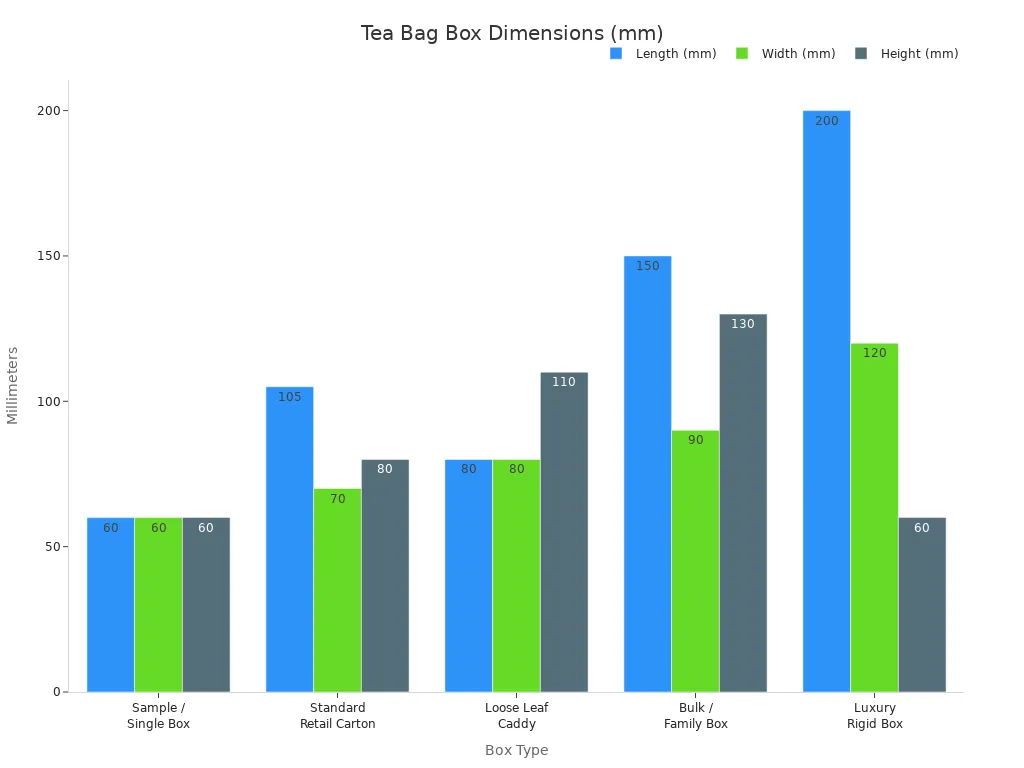
Tea bags and sachets need small packaging that focuses on ease of use. A normal tea bag box is 3x2x4 inches and fits 15-20 wrapped bags. Pyramid sachet boxes are taller at 4x3x5 inches. A regular store carton at 105×70×80 mm holds 20 tea bags well on grocery shelves.
The inner bag type affects your outer box choice. Pyramid tea bags fit premium whole-leaf teas, big-leaf herbal mixes, and chunky fruit blends. Their 3D shape lets leaves open fully when brewing. Regular flat filter bags work best for tea fannings, dust, and standard CTC black teas. These tiny bits do not need space to expand.
Wrapping each bag separately raises your cost per unit. Every bag needs paper or foil, plus tags and strings. This extra material also harms the environment. Your tea packaging box design must balance these trade-offs while keeping the opening simple for everyday use.
Loose leaf tea needs room to stay intact without getting crushed. A loose leaf caddy at 80×80×110 mm holds 50-100 grams of leaf. Big family boxes reach 150×90×130 mm for larger amounts. The extra space stops leaf breakage that ruins both look and taste.
Protection matters more for loose leaf because you sell it without individual wrapping. Your packaging must be airtight with strong barrier features. Tea easily soaks up moisture and smells during storage. Light and heat speed up damage, causing stale flavors. Food-grade tin cans with disposable screw caps do great at blocking moisture, light, and odors.
Stand-up pouches are another good choice for loose-leaf teas, premium mixes, and herbal blends. These pouches often have resealable zippers so customers can open and close them many times. Window pouches let buyers see whole-leaf quality before buying.
The packaging cost per serving for loose leaf is lower because you skip individual wrapping. You also avoid microplastic risks from plastic mesh tea bags. Your main design goal shifts from convenience to keeping flavor and aroma safe. Airtight containers like tins or resealable pouches keep that freshness much better than plain paper boxes. Custom boxes let you adjust size and protective features to match your exact product.
Your material choices shape your environmental impact. Many tea brands now turn to renewable and recycled options. You can select kraft paper, bamboo, sugarcane fiber, or recycled cardboard for your outer boxes. These materials come from fast-growing plants or reused fibers. They reduce demand for virgin trees and lower your carbon footprint.
Your production methods matter too. Look for suppliers with FSC certification. This label confirms wood comes from responsibly managed forests. Yison Printing holds ISO 9001, FSC, and BSCI certifications. These standards ensure quality management, sustainable sourcing, and ethical production. When you partner with a certified manufacturer, you verify your entire supply chain meets environmental expectations.
Smart packaging design reduces waste before your product reaches shelves. You can choose minimalistic structures that use less material without sacrificing protection. Innovative folding techniques and inserts save space and cut excess packaging. Lightweight boxes also lower shipping costs and reduce fuel consumption during transport.
You can maximize recyclability through thoughtful choices. Use recyclable cardboard tubes with home-compostable PLA liners. Choose compostable sachets for loose-leaf iced tea. Select FSC-sourced papers with soy-based ink for gift boxes. These options let customers dispose of packaging responsibly. Clear labels teach buyers how to recycle or compost each component. This education turns your packaging into a tool for environmental awareness.
Your budget shapes every packaging decision. Custom tea boxes start at $0.10 per unit. Cardboard boxes range from $0.70 to $6.00 per unit. Kraft boxes cost $0.44 to $2.25. Paperboard boxes run $0.18 to $2.50. Corrugated fiberboard boxes fall between $0.05 and $2.93. These prices vary with size, material, and print complexity.
Volume changes your cost dramatically. A standard 3.5x2.5x5 inch folding carton costs $2.40 to $3.60 per unit for 100 units. That price drops to $1.15 to $1.85 per unit for 500 units. At 1000 units, you pay only $0.80 to $1.35 per unit. Additional features like window patching, foil stamping, embossing, and interior printing add $0.20 to $0.75 per unit. Calculate your true cost by adding these extras to your base price.
Minimum order quantities (MOQs) vary by packaging type. Many suppliers require 100 units as their starting point. Sample orders also demand a 100-piece minimum. Bulk discounts apply for larger orders. You must factor these MOQs into your budget planning. A lower per-unit price means little if you cannot meet the minimum.
Yison Printing offers complete packaging solutions with ISO 9001, FSC, and BSCI certifications. Their tea packaging boxes combine quality materials with customizable designs. A trusted partner helps you balance cost, lead time, and quality for your brand.
Your tea packaging box shapes how customers perceive your brand before they taste your product. Start with your brand identity, then evaluate materials and design. Match your choice to your tea format. Prioritize sustainability. Balance your budget with supplier selection.
Quality packaging design delivers real returns. Rigid can packaging supports retail price premiums of 30% to 50% over identical products in pouches. This investment pays off through expanded profit margins and stronger customer loyalty.
Your packaging influences consumer choices daily. Choose wisely. The right tea packaging box is an investment in brand growth, not just a container. Partner with a certified supplier like Yison Printing to bring your vision to life.
Your choice depends on your tea type and brand image. Paperboard works well for tea bags and offers easy printing. Tinplate provides strong protection and a premium feel. Pouches block oxygen and moisture effectively. Consider your product's needs before deciding.
Tea bags need compact boxes with easy-open features. Loose leaf tea requires spacious, airtight containers that prevent leaf crushing. Resealable pouches or tin containers with tight lids work best for loose leaf. Your packaging must match your tea format for optimal freshness.
Look for ISO 9001 for quality management, FSC for sustainable sourcing, and BSCI for ethical production. Food-grade certification is mandatory for tea packaging materials. These certifications confirm your supplier meets environmental and safety standards. Yison Printing holds all these certifications.
Choose recyclable materials like kraft paper or cardboard. Select PLA liners that compost in industrial facilities. Use minimal packaging structures to reduce waste. Print disposal instructions on your boxes. These choices appeal to eco-conscious customers and reduce your environmental footprint. Your packaging design directly impacts sustainability.


